The Reflexive AI Initiative

The mission of The Liberators has always been "to liberate individuals, teams, and organizations from dehumanizing and ineffective ways of organizing work by putting them in control of shaping their future". I find it helpful to periodically ask myself the question "What is currently an area where liberation is sorely needed?".
One such area is how the workplace is changing in response to the emergence of artificial intelligence. This technology is reshaping work substantially and broadly, and in an increasing number of fields. While AI is often framed merely as a neutral tool to improve productivity and efficiency, technologies always embody forms of power and authority, shape how we see and understand the world, and impose behaviors on humans. While AI can be used to improve job satisfaction, support employees, and expand their autonomy, it can also be leveraged as a tool for control, monitoring, displacement, and oppression. The prevalent productivity frame of AI also ignores that this technology is often provided exclusively through large tech companies that pursue their own economic — and sometimes political — interests. Thus, treating AI as "just a tool" is naive and dangerous. Yet a quick glance at my LinkedIn feed often makes me feel as if we are rushing along with this technology and its myriad hypes out of fear of missing out on the next big thing. Job titles changed from "agile coach" to "AI delivery coach" (or something similar) almost overnight. Companies rush to add AI features into tools where the actual use case is minimal at best. And AI slop is everywhere these days.
Contribute to the Reflexive AI Initiative
I'm not categorically against AI. I think it's a powerful technology if used ethically and responsibly. But it requires us to make many decisions we never had to make before. For most tasks, it is now possible to let Claude, Gemini, Grok, or DeepSeek do it for you. Yes, you seem hyper-productive, but the work was actually done by an LLM. We outsource creativity, critical thinking, and problem-solving to technology. Of course companies also see this, and, pressured by stakeholders seeking profit, it is only rational for them to conclude that more and more work can be outsourced to AI, reducing the number of employment contracts needed — whether that is wise or not, and whether or not it creates major issues downstream as critical skills effectively leave the company. It is also easy to predict that this will significantly change the power balance between employers and employees. This is already happening in software engineering, where engineers skeptical of AI have no choice but to participate out of concern they might lose their job to someone who is more willing to go along. On a societal level, many jobs risk becoming superfluous. A case in point is the native-AI law firms where only a few partners manage a host of AI agents to perform legal work formerly performed by junior associates or paralegals. If such firms gain traction, as seems to be the case, what is the future for law students? It would be naive not to anticipate such changes in most office-based professions. And the rapid advances in robotics are likely to challenge physical work in the coming years as well. This will create substantial societal shifts and change power balances.
And this is where it ties back to the mission of The Liberators. AI is a technology that can easily dehumanize the workplace. In fact, studies show this is already happening in some fields. AI can undermine motivation, a sense of meaning, and work fulfillment, and break down the social bonds in organizations. The risk here is that we undo decades of insights from organizational psychology and behavior — that organizations are built on motivated employees.
Introducing the Reflexive AI Initiative
This is why we started the Reflexive AI Initiative. It is our attempt to take a step back and explore how AI can be used in a human-centered manner, rather than in a manner that dehumanizes and demotivates. We recognize the potential that AI holds for organizations and we want to help them embed it in a manner that is human-centered; it supports employees, expands autonomy, improves work satisfaction instead of their opposites. We also recognize that this is difficult. It requires reflection and reflexivity; to step back for each decision involving AI and asking "How is this informed by our values, and how does it align with them?".
The initiative is based on action research. This is a research approach where professionals and academics work together to address a societal challenge by developing knowledge together. It is run through a non-profit, the Lucid Institute for Organizational Science (LIOS) and all materials we produce are open source. None of the participants are paid for their contributions or work.
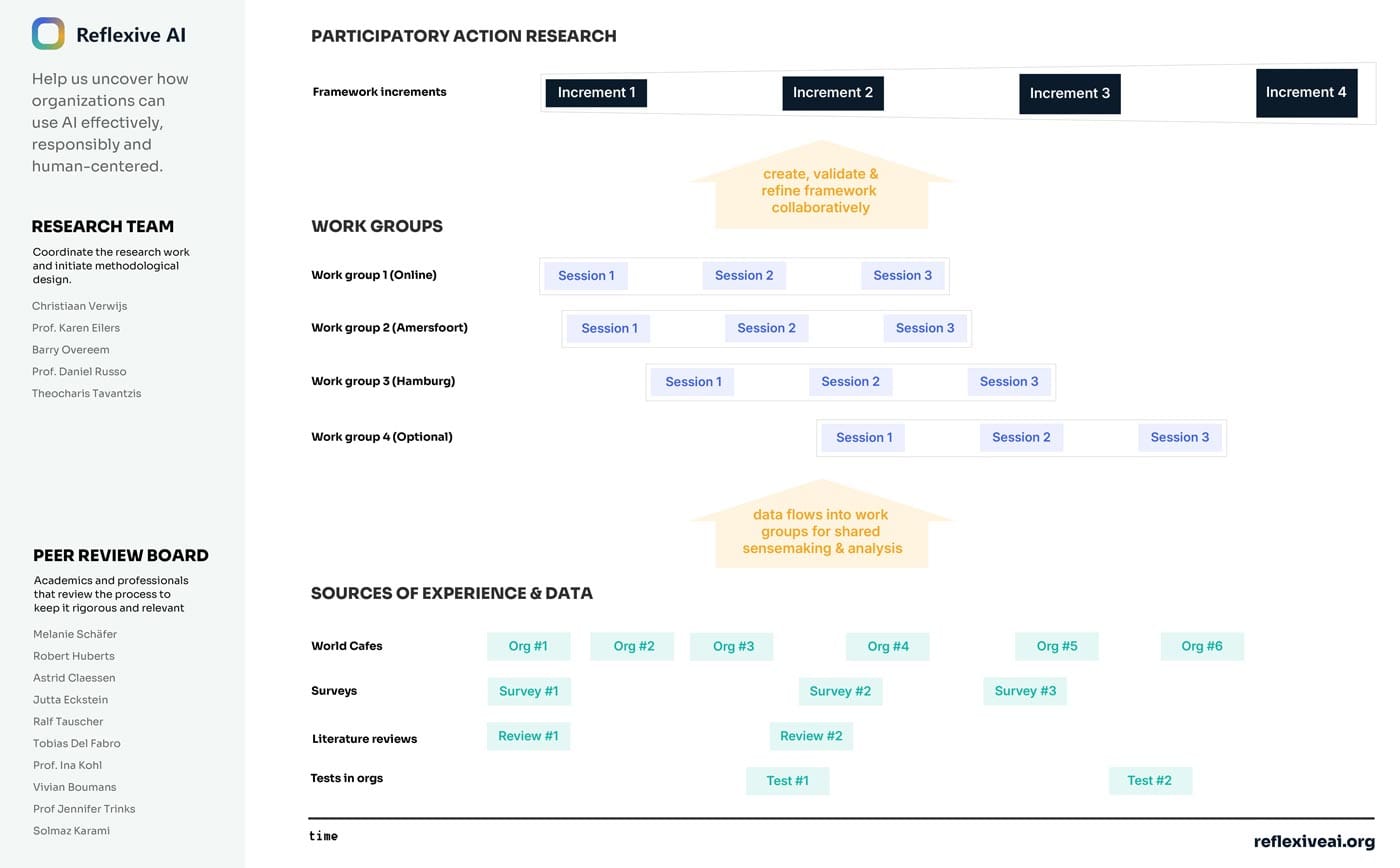
We are proud to do this with researchers like Prof. Karen Eilers, Prof. Daniel Russo, Theocharis Tavantzis, and a wonderful peer-review board of professionals and academics. It is important that we develop frameworks, interventions, patterns, and anti-patterns to help us avoid rushing along in the AI hype so quickly that we forget what actually makes organizations effective — the people that work there.
Join us at reflexiveai.org. There are many ways to contribute. You can join one of our work groups to develop interventions, host a World Cafe to reflect on AI in the workplace in your organization or in other ways.
This post was written by me. AI was used only for the purpose of spell- and grammar checking.