How do we make the "Big Five" meetings the exception?
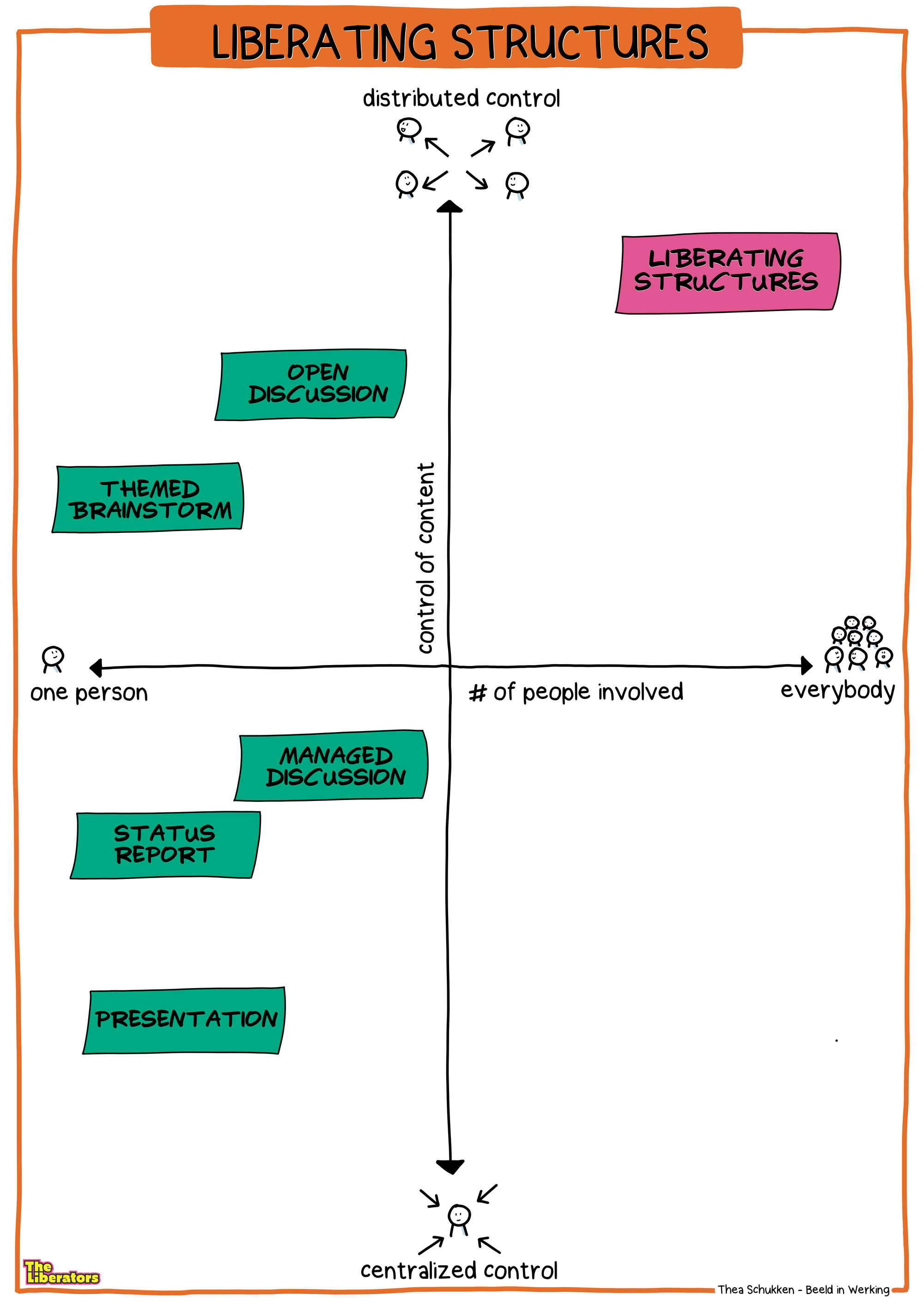
Liberating Structures has offered alternatives to the Big Five for more than a decade. So why do we keep falling back on presentations, status reports, managed discussions, open discussions, and brainstorms?

Although Liberating Structures has been around for more than a decade, the five conventional ways of meeting and collaborating remain remarkably persistent. Presentations, status reports, managed discussions, open discussions, and brainstorms are still the default in many organizations.
I'm not surprised anymore, because even at Liberating Structures gatherings, surrounded by experienced practitioners, I've seen presentations, open discussions, and conventional brainstorms take over. Apparently, knowing alternatives doesn't automatically change our habits.
In general, the five conventional structures tend to over-control participation while under-engaging the people in the room. They:
❌ Give disproportionate airtime to the fastest, loudest, or most senior voices.
❌ Turn many participants into spectators rather than contributors.
❌ Reinforce existing hierarchies and make minority perspectives harder to hear.
❌ Slow down collective thinking by involving people one at a time.
❌ Leave much of the experience, creativity, and intelligence in the room untapped.
So how do we move away from these deeply ingrained habits?
My approach is simple: start small and focus on experience over explanation. I rarely announce that we're going to use a Liberating Structure. The name itself can create unnecessary resistance: another method, another framework, another thing to learn.
Instead, change how people interact and let them experience the difference.
In the context of the Big Five, this could look like:
👉 Presentation: let people explore the content through a Gallery Walk
👉 Open discussion: give everyone a voice with 1-2-4-ALL
👉 Themed brainstorm: generate and prioritize ideas with 25/10 Crowd Sourcing
👉 Managed discussion: structure the conversation with a Conversation Café
👉 Status report: let people exchange updates through Impromptu Networking
Of course, none of this is new. Liberating Structures has offered alternatives like these for more than a decade, and many practitioners already use them. Yet the Big Five remain remarkably dominant, even though so many of us regularly complain about their ineffectiveness.
Clearly, knowing and experiencing better alternatives isn't enough. Something keeps pulling us back to the familiar. The Big Five aren't just meeting formats; they're deeply ingrained organizational habits.
That's also where my own exploration is heading. I want to work more closely with organizations to understand what it takes to make this shift stick.
How do we prevent Liberating Structures from remaining a niche practice for facilitators and enthusiasts? How do we make inclusive collaboration the default, and the Big Five the exception?
I'll keep sharing my ideas and experiments, and I'll continue hosting public meetups to explore this together. Because obviously, I can't change this alone. 😅
What have you seen actually help organizations move away from the Big Five?