Five Insights From The Reflexive AI Work Group

"Computers that do the sorts of things that minds do" is how the cognitive psychologist Margaret Ann Boden pragmatically defines Artificial Intelligence. It highlights well the nature of the technological revolution that is unfolding. Where the industrial revolution was about replacing physical labor with steam-powered engines, and the internet revolution was about mass communication, the AI revolution is about delegating thinking, decision-making, and creativity to computers.
This fundamentally reshapes those workplaces where minds are the primary instruments. While AI holds plenty of potential for organizations to improve quality, responsiveness, and effectiveness, there is a risk that cost-saving and the need to remain competitive may drive organizations to replace minds with AI rather than support them. This will likely end up harming employees, the organizations themselves, and society at large.
The genie of AI can't be put back into the bottle. What we can do is help organizations leverage AI in a manner that supports, empowers, and motivates employees. Or, more simply: to use AI not to replace people, but to make them more effective and their work more enjoyable. Exploring what that should look like is the aim of the Reflexive AI Initiative.
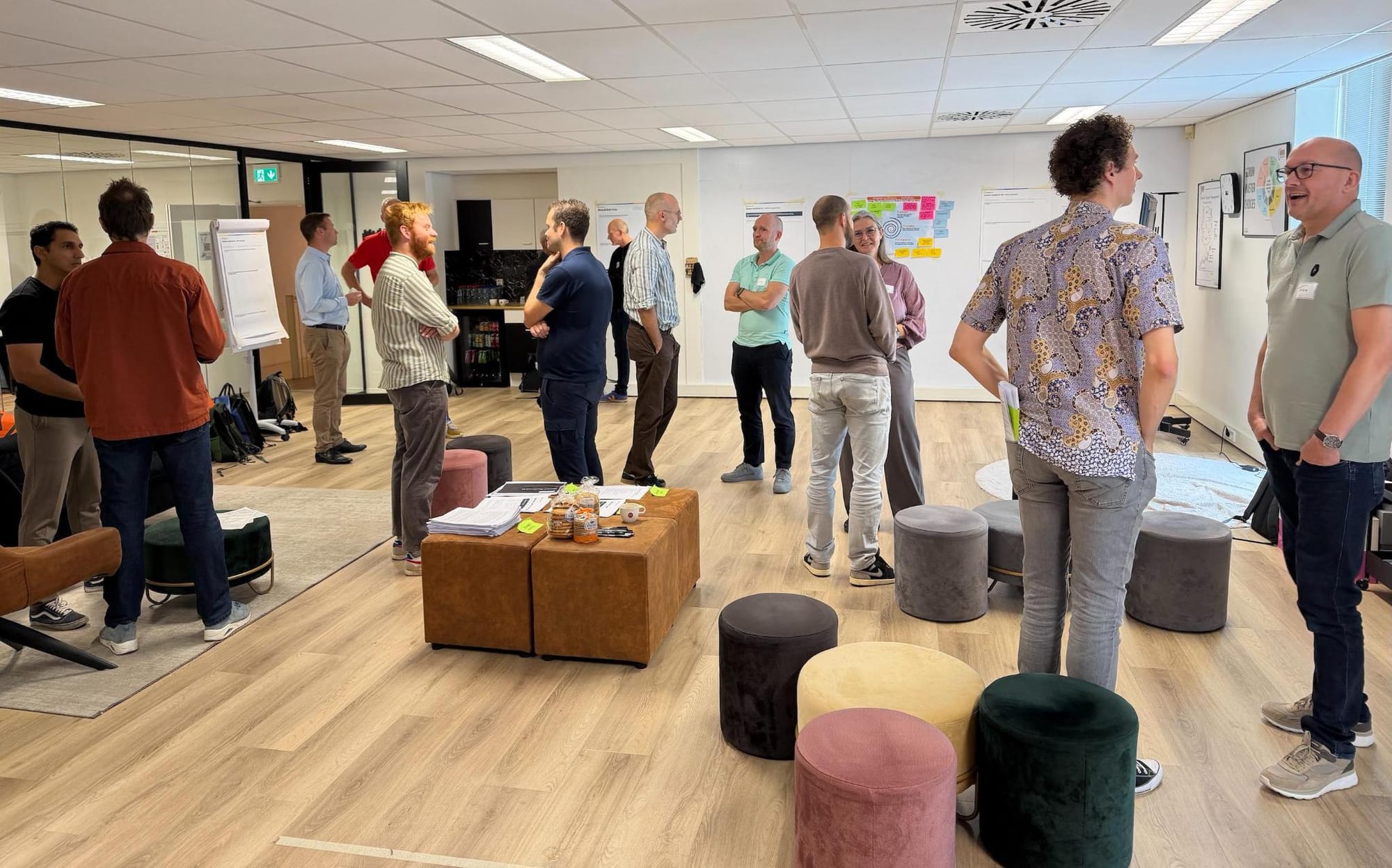
On October 2, 2026, the Work Group Amersfoort met for the first time. The session was attended by 15 participants with diverse perspectives. It was a blast! With highly engaged participants, intense discussions, lots of laughter and creative thinking. In a 3-hour facilitated session, we explored the following questions:
- What do we mean by "human-centered AI"?
- When organizations want to ensure their AI use is human-centered, what does that look like in practice?
- What processes, strategies, structures, interventions, and practices help ensure that AI use remains human-centered?
- How can this be tracked, monitored, measured, and audited to ensure it remains human-centered?
This is an iterative and incremental process. The work group will meet two more times, in November and December, to develop a governance framework that addresses these questions, alongside other Work Groups starting in other regions. All results and intermediate outcomes are published publicly on GitHub. The full facilitation guide we followed, which was reviewed by our 10-member Peer Review Board, is available for download here.
In this post I share five insights from the first session.
The genie of AI can't be put back into the bottle. What we can do is help organizations leverage AI in a manner that supports, empowers, and motivates employees. - Reflexive AI Initiative
Insight #1: We need a better definition for human-centered AI
"What is human-centered AI, exactly?" is a question that came up a lot. Although it is currently a topic of active scientific inquiry, there is no clear-cut, agreed-upon definition available yet. For example, the Copenhagen Manifesto for human-centered AI, which was created by 35 academics, proposes five core values and twelve principles but does not provide a cohesive definition. In scientific literature, the concept is sometimes narrowed to just the notion of the "human-in-the-loop", where a human is always part of any decision-making process that involves AI. But the participants of the work group argued against this definition, noting it was too passive and reactive, and preferred "human-in-the-driver-seat".
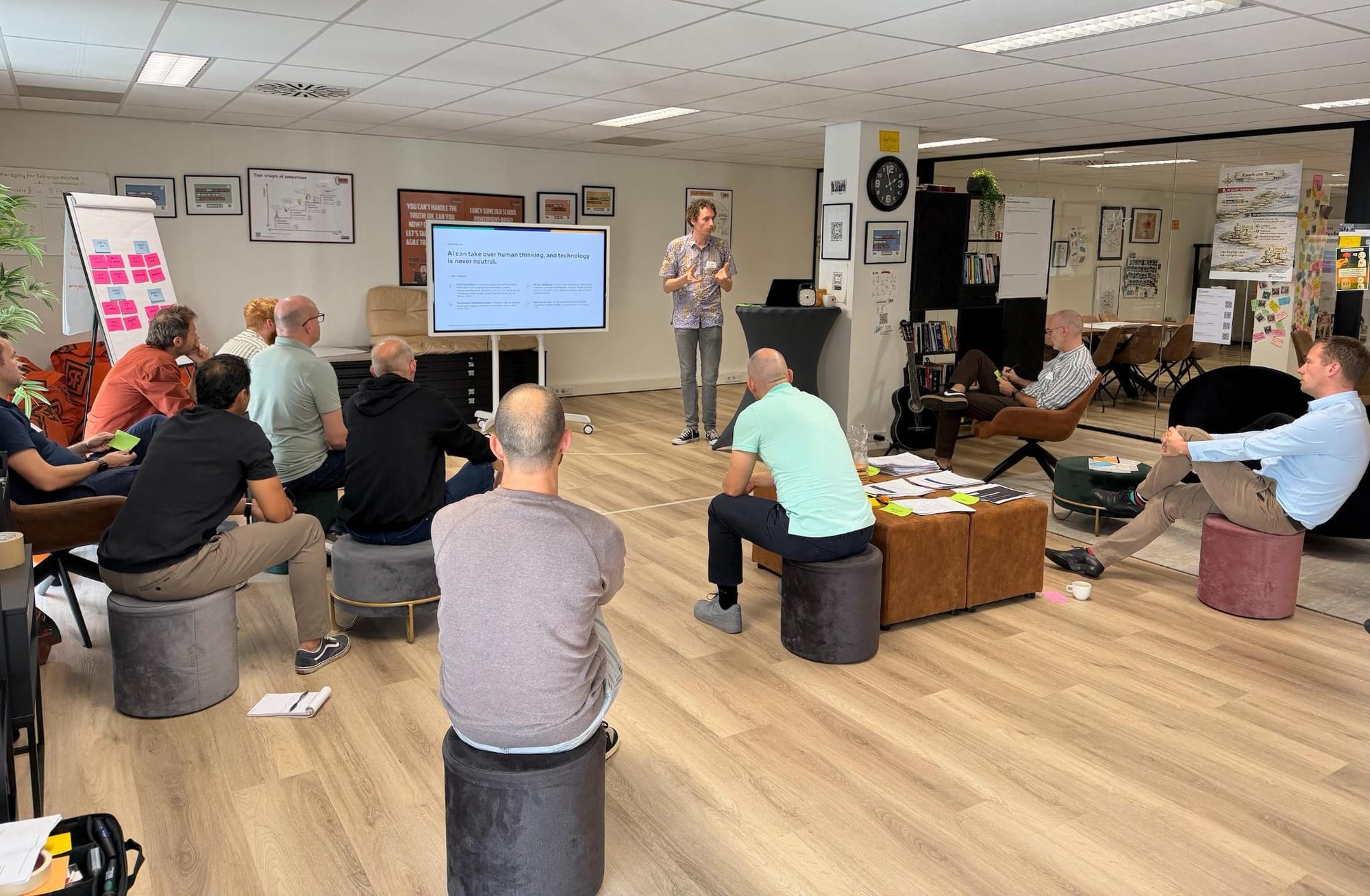
We did provide participants with a working definition of human-centered AI, just to have a starting point. Together with researcher Theocharis Tavantzis, who specializes in human-centered AI, we created the following definition: "creating and using AI to help people perform their work more efficiently (faster and more accurately), while making sure that they remain in control, feel motivated, stay socially connected to their colleagues, and understand how AI affects them, with the autonomy to question, change, or reject its decisions." But this definition also feels quite narrow and task-focused.
Fortunately, one aim of the initiative is to define human-centered AI more precisely. To this end, we are collecting insights from participants of the Work Groups and World Cafés to create a more bounded definition. What this definition will be is still an open question. But I do feel that this is mostly a matter of finding the right words to express what most of us already seem to feel intuitively. I did notice that even though participants asked questions about the definition, they seemed perfectly able to articulate what the opposite looks like.
Insight #2: Hard work, but many minds make it lighter
In a debrief at the end of the first session, one participant observed that it had been "hard work", but also that it was doable because everyone was thinking about it together. This also reflected a concern we had while designing the Work Groups: would it be too difficult to answer questions like "What should power and dynamics look like in human-centered AI?" or "How can work be made and kept meaningful in human-centered AI?" These are broad questions about abstract concepts. And even though the various sub-groups certainly struggled with the questions at times, we also observed that all groups generated a lot of ideas and potential answers.
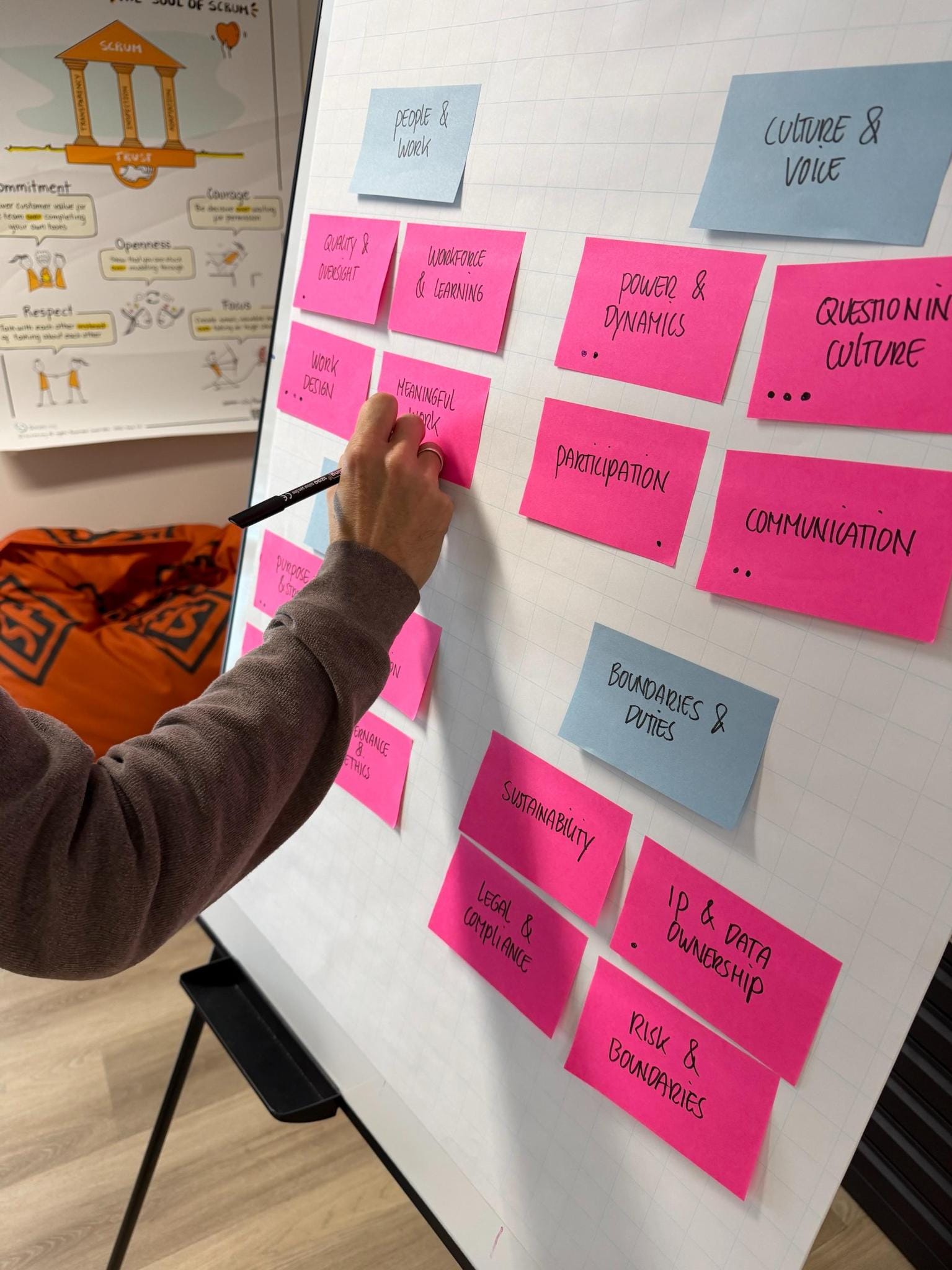
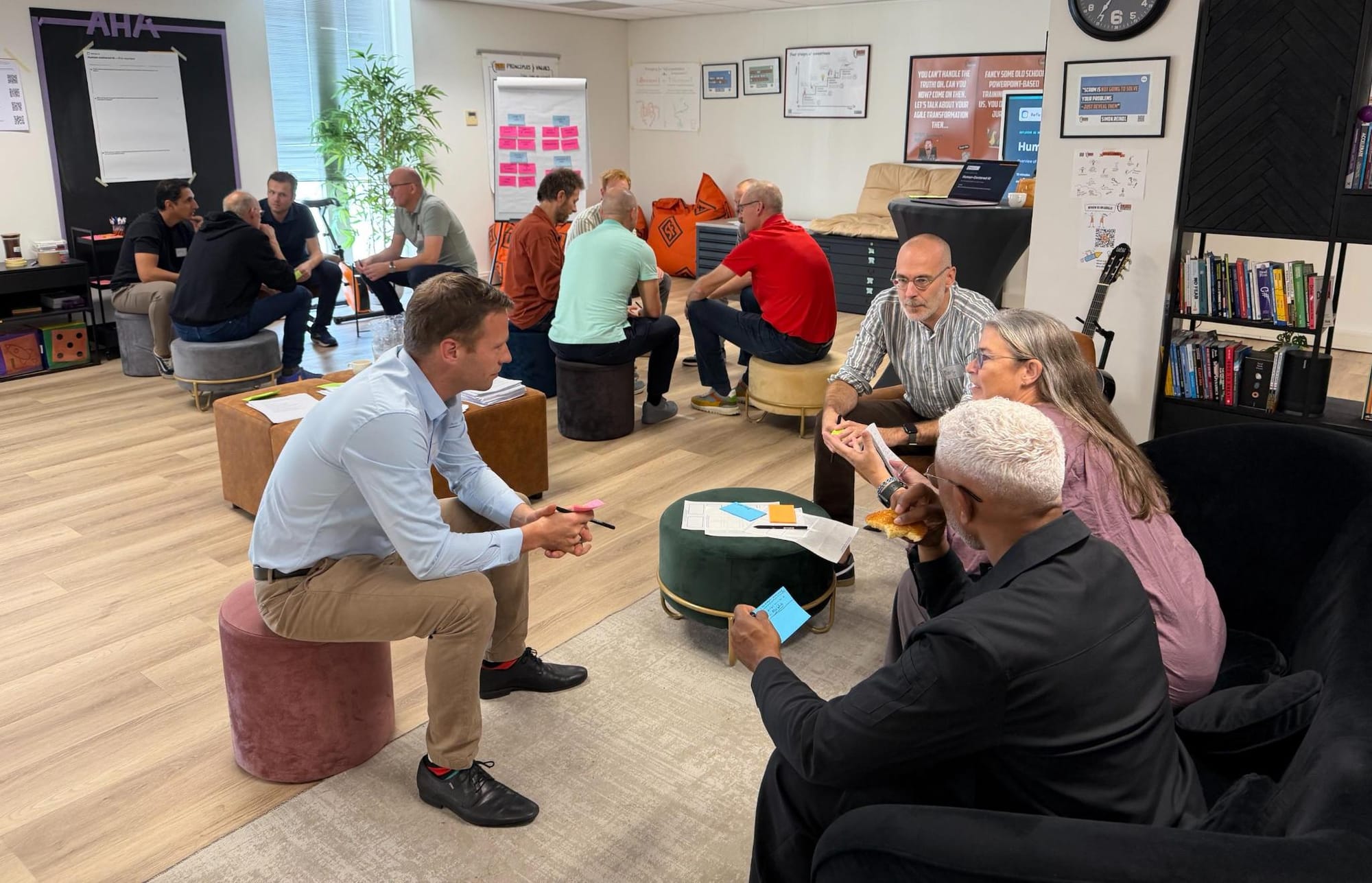
That we managed despite the difficulty shows how motivated everyone is. It also shows that the facilitation choices we made paid off. A common mantra in Liberating Structures is that "the structure takes the strain", and we certainly observed this during the session. One example is how the group split into sub-groups to work on themes (see picture below). After spending 45 minutes on their own theme, we used a Shift & Share to bring fresh eyes to each topic and build on each other's ideas. Another example is how we used a Pre-Mortem exercise to leverage prospective hindsight as a cognitive "trick" to reason backwards from failure outcomes and identify what would have prevented them.
Insight #3: Is the medium the message?
What does a good outcome look like for this group? This question has been on my mind for the past two months as we designed the overall flow for the three sessions. A good outcome would likely be a governance framework that is both practical and general enough to apply across a broad range of organizations. But during the first session, I realized that perhaps the medium was also the message.
What would happen if you formed a work group within your organization to think about human-centered AI and followed the facilitation guide we created? It would raise all the relevant questions and actually create a process to implement changes incrementally and iteratively throughout the sessions. As a Work Group, we may be able to make this process as easy as possible by providing good starting points, practical examples, and solid guidance.
Insight #4: Using data is difficult
The Reflexive AI Initiative is a collaboration between researchers and professionals. In scientific research, data is used to develop and validate theories and models. This is a good way of grounding ideas in what is really happening, and it reduces personal bias.
One design principle for the Work Groups is that we want to ground what we design in data. Professional experience is a valuable source of data, but we purposefully want to elevate the discussions beyond personal experience and include other sources of data to broaden our perspectives. To this end, we provided the Work Group with three additional sources of data: a thematic analysis of expert interviews performed by Zelal Keskin, a comprehensive literature review, and insights from organizations that have run our Reflexive AI World Cafe.
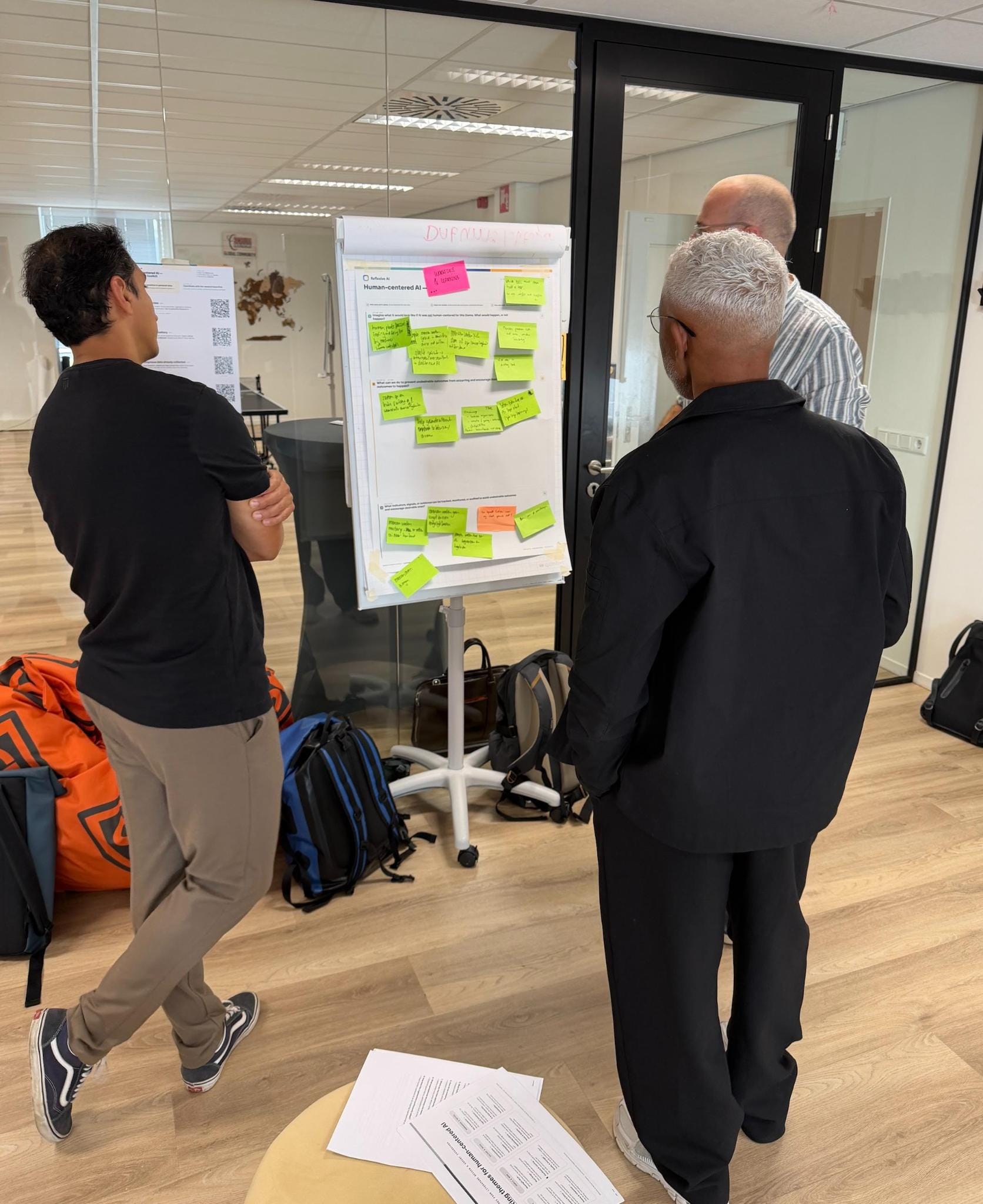
However, most sub-groups found it difficult to use data other than personal experience. We did not have time to explore more deeply why this was hard. Maybe the format was not suitable, or the data was not relevant enough or not explained sufficiently. Either way, this is something we should improve for future sessions.
One way we could facilitate this is by clarifying how data sources can help achieve a form of "theoretical saturation". The questions asked of participants were hard (like "What does human-centered AI look like for workforce development?" and "How do we measure or monitor if AI use in workforce development is human-centered?"). Fortunately, similar questions were asked of experts and World Café participants. Their anonymous answers already provide a lot of insights that might help answer the questions during the Work Group. So one approach we could recommend more explicitly is to go through the data (including personal experience) and pick out everything relevant to a question until no new insights emerge.
Insight #5: Action research is developing knowledge through practice
We closed the session by asking all participants to identify one concrete action they could take within their own organization to test, develop, or iterate on a part of the framework we are developing. In our next session in November, we will evaluate with participants how their actions worked out, what went well, and what challenges they ran into. This can help us identify what else is needed.
This illustrates how action research, as a scientific approach to societal challenges, is about developing knowledge through practice. We are not just dreaming up frameworks, models, and theories in isolation, but testing them in the real world as we develop them. Nor does this process happen in the ivory tower of scientific institutes, exclusively by trained researchers. It happens in practice, by professionals in collaboration with researchers.
It's also an opportunity to thank the action researchers Melanie Schäfer and Vivian Boumans, who kindly joined our Peer Review Board, critiqued our methodology, and helped us vastly improve how we practice action research.
What's next?
The Work Group will meet again in November. The aim of that session will likely be to deepen the work done in the first session, informed by the experiences with the first actions.
- You can follow the outcomes on our public GitHub repository.
- Follow upcoming events on the Reflexive AI Initiative website.
- Want to contribute to the initiative? A great way to do so is to run a 2-hour World Cafe in your organization based on a facilitation guide we created. The anonymized data will be used by the work groups to test, evaluate and develop the framework.
Although the Work Group Amersfoort is full. You can still join our online work group or the work group that will be scheduled in Hamburg. Dates are on the Reflexive AI Initiative website. Email us at info@reflexiveai.org to sign up. We may schedule more work groups in the Netherlands in 2027. If you'd like to be on the list, let us know.
The Reflexive AI Initiative was initiated by Christiaan Verwijs, Prof Karen Eilers, Barry Overeem, Prof Daniel Russo and Theocharis Tavantzis. It is non-profit, volunteer-run and open source.
We thank our peer-review board for reviewing and critiquing our approach at every step: Melanie Schäfer, Robert Huberts, Astrid Claessen, Jutta Eckstein, Ralf Tauscher, Tobias Del Fabro, Ina Kohl, Vivian Boumans, Solmaz Karami and Jennifer Trinks.